
Greenwich Released Mugshot Records
A mugshot, also called a booking photograph, depicts a person during an arrest or custody process. Release does not by itself erase the agency record. Yet a photo and a current custody status answer different questions. A released person may have left Greenwich Police, court, or DOC custody while an arrest image remains subject to Connecticut records law. The case may also end in dismissal, nolle, acquittal, pardon, or another result that changes later access.
Greenwich Police does not publish a mugshot gallery. No official 24-hour or 72-hour photo feed was found, and no Greenwich police mobile app was found that displays recent releases or booking photos. The correct local path is a focused request to the Police Records Division. Ask for the “booking photograph associated with the arrest or custody event, if one exists and is releasable.” That wording does not assume every arrest produced a photo or that every image must be disclosed.
A released mugshot should never be read as a statement of guilt or the present case status. Use the Stamford court record to check disposition, sentence, dismissal, or other judicial action. Use the custody agency for release facts.
Greenwich Released Mugshot Sources
The source depends on custody. Greenwich Police may hold a local booking photo. CT DOC may hold an intake image after state commitment. A court file identifies the case but generally verifies charges and disposition rather than serving photos. Other public sources may repeat images, but only the creating agency can address its official record.
| Channel | Has a photo? | How to access it |
|---|---|---|
| Greenwich recent-release roster | No official roster found | There is no local sheriff photo feed or rolling release list. |
| Greenwich Police Records | Possible, if created and releasable | Use the online or paper records request with exact event details. |
| Official police mobile app | No app found | No official Greenwich release or mugshot app was identified. |
| CT DOC | Possible in a live record or agency file | Use the inmate search as a custody source, then request DOC records if needed. |
| Stamford court records | Generally no | Use the docket to identify the correct case, date, and result. |
| News or official press release | Sometimes | Treat it as secondary and confirm the image and case with the official agency. |
| Commercial aggregator | Sometimes | Do not rely on stale, scraped, or monetized copies as the official record. |
Connecticut VINE is a custody-notification tool, not a permanent mugshot archive. A released status can help identify when custody changed, but it should not be presented as a photo source unless the current official interface actually displays an agency image. Federal BOP and ICE records are also separate from Greenwich and CT DOC.
Request Greenwich Booking Photos
The Greenwich Police General Services Division accepts police record requests online and on paper. A good request identifies the record without demanding a broad personal history. Include enough event facts to distinguish the person and arrest, then let the agency apply exemptions or redactions required by law.
- Gather the full name, arrest date, approximate time, place, and CFS or case number if known.
- Open the official online form or download the Greenwich Police paper request form.
- Ask for the booking photograph linked to that arrest or custody event, if one exists and is releasable.
- Add the arrest report, custody entry, or release or transfer record only if those records are also needed.
- Submit online, mail the form, or hand deliver it during Police Records hours.
- Review the agency's response, cited exemption, redaction, fee, and payment instructions.
The Police Records Section is at 11 Bruce Place, Greenwich, CT 06830. Hand delivery is available Monday through Friday from 8:30 AM to 4:15 PM, and questions go to (203) 622-8024. Greenwich says routine requests generally take 5 to 7 business days. It lists $0.50 per page, $19.50 per CD or DVD, and $26 for a flash drive. Advance payment may be required when expected cost exceeds $25.
The request can be denied or limited for a juvenile matter, erased or sealed record, protected victim details, open investigation, or another legal exemption. A lawful denial does not establish that no photo was ever made.
Connecticut Mugshot Access Rules
Connecticut General Statutes section 1-215 governs arrest-record access. It defines the record of arrest and requires disclosure subject to listed redactions, sealing orders, erased-record rules, juvenile limits, and other applicable exemptions. Subsection (c) also addresses other law-enforcement records that document or depict arrest or custody while a prosecution is pending. A booking photo may fall within that records framework, but the statute does not create an online Greenwich gallery.
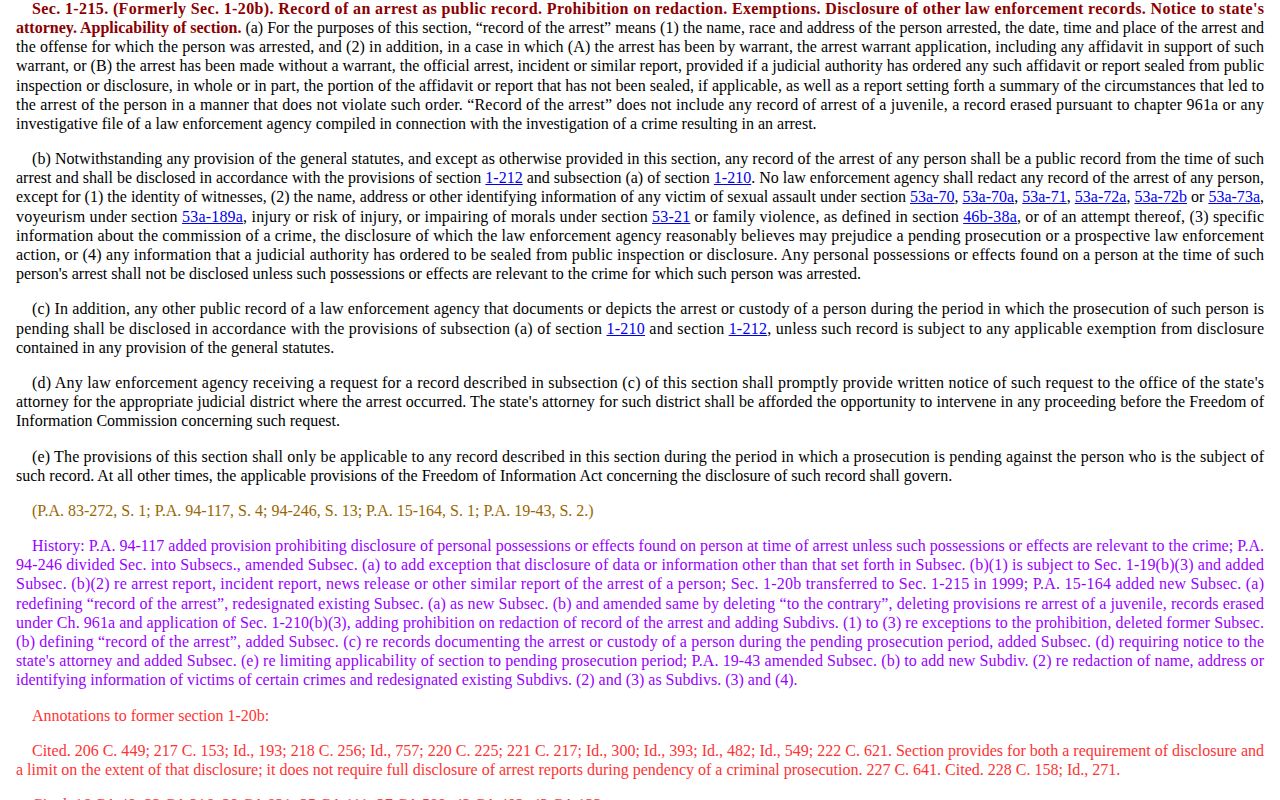
The statute screenshot anchors the official public-record path. It should be read with section 1-210 exemptions and the facts of the specific case, not as a promise that every custody image is available without review.
The research found no Greenwich-specific booking-photo publication policy and no Connecticut anti-pay-to-remove mugshot statute. That absence should not be turned into a claim that a commercial publisher has unrestricted rights. Official records law, erasure, sealing, privacy protections, and case-specific limits still govern agency access.
DOC Photos After Greenwich Release
The CT DOC inmate-search page is the official statewide custody route after a Greenwich case enters correctional custody. It should not be described as a mugshot gallery. A public detail record may contain an image in the live interface, but its primary purpose is inmate information. Public examples also carry identity, location, status, admission, and release-related fields.
A Greenwich-related man may enter Bridgeport Correctional Center because that facility serves Stamford courts. York Correctional Institution serves women from all Connecticut Superior Courts. If a released person no longer appears in the public current-inmate search, request any legally needed and releasable intake image from DOC. Public Information handles status questions; External Affairs Freedom of Information handles formal record requests.
Do not substitute a DOC image for a Greenwich Police booking photo. Each depicts a different custody event. Court information can help identify whether the person was ever committed to DOC, which prevents a request from going to the wrong agency.
Note: A photo from DOC confirms a state custody record, not the precise outcome of the underlying Greenwich court case.
No Greenwich Mugshot Feed
Greenwich's Crime Data Portal reports law-enforcement activity and incidents, not released mugshots. The town describes a daily update that reflects previous-day information, but warns that data may be preliminary, incomplete, withheld, or generalized. No booking-photo or release-date field is promised. Finding an incident there may help supply a date or CFS context for a record request, but the portal cannot verify release or guarantee an image.
This distinction also applies to the Released Last 24 Hours path. Since Greenwich has no local recent-release list, there is no roster photo to preserve after a name drops off. Request the agency photo directly instead of assuming a missing feed means the record does not exist.
Erasure Changes Greenwich Mugshot Access
Connecticut erasure can change what a released-person search returns. Under section 54-142a, qualifying records may be erased after outcomes such as dismissal, nolle, acquittal, or pardon. The Judicial Branch defendant search also warns that criminal history information can change each day due to erasures, corrections, pardons, and other modifications.
A missing court result or agency record is therefore not always a failed search. It may reflect a changed legal status, a sealed or juvenile matter, a different court location, or a mismatch in the entered details. Ask the record-holding agency to apply current law. Do not assume that an old copy held elsewhere remains accurate because it still appears online.
Erasure is distinct from release. Release means a custody system stopped holding the person. Erasure changes the legal treatment and public visibility of records. A person may be released while a case continues, or an older case may later qualify for erasure.
Secondary Greenwich Mugshot Copies
Local news or an official police press release may publish a photo in a specific case. That is not a complete database. News coverage tends to focus on selected events, and an image may remain attached to an early report after the case changes. Check the date, caption, named agency, and later court result before treating it as current.
Commercial mugshot and aggregation pages may hold scraped, stale, incomplete, or monetized copies. No such site should control release verification, and none is linked here. Do not pay a removal service based on an unsupported promise. Direct questions about an official image to Greenwich Police or CT DOC, and direct questions about a court result to the Judicial Branch.
Before using a secondary image to identify the event, compare it with official facts that do not depend on the picture. The arrest date, agency, court location, case number, and custody path provide a stronger match. Similar names and old captions can lead to the wrong person or wrong case. A secondary publisher may also fail to update a dismissal, erasure, correction, or later court disposition. The official record should control both the identity match and the current status.
If an official agency page still displays an image after a legal change, contact that agency and identify the exact page and record. The agency can determine whether current law requires a change, redaction, or restriction. A news organization or other publisher controls its own copy, but a request should still cite the updated official source. Connecticut research did not identify a special Greenwich removal procedure, so avoid claims that removal is automatic.
The Greenwich County released-inmate lookup helps identify the correct custody and court channels before a booking-photo request is filed. Keeping the photo request tied to an exact event reduces mistaken identity and directs the request to the agency that can lawfully respond.